
Oral Appliance Therapy for Sleep Apnea
Do You Struggle With CPAP? Ask Us About Oral Appliance Therapy.
We work with dentists who offer custom appliance therapy, a proven alternative to CPAP for qualified patients. Contact us at (615) 893-4896 to discover if it’s right for you.
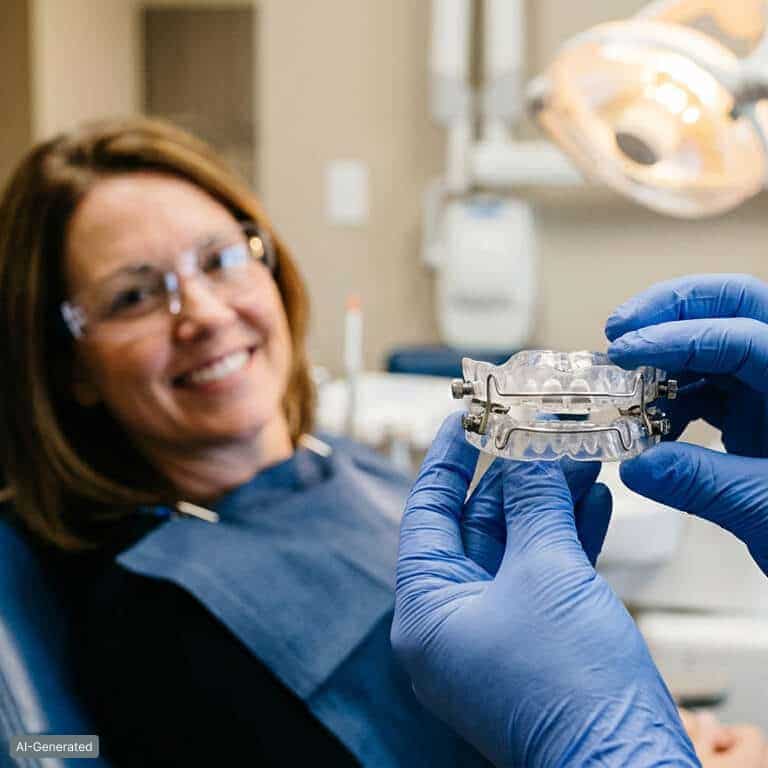
Sleep Apnea Treatment Without the Machine
Custom Oral Appliances for Sleep Apnea and Snoring
For many patients, CPAP therapy is the right answer, but it’s not the only answer.
Oral Appliance Therapy (OAT) offers a clinically proven, comfortable alternative for patients with mild obstructive sleep apnea or those who struggle to tolerate CPAP.
A custom oral appliance is designed and fitted by a Board-Certified Dental Sleep Medicine specialist, working in coordination with your sleep physician to ensure it’s appropriate for your diagnosis and medical history.
The Science Behind It
How Does Oral Appliance Therapy Work?
Obstructive sleep apnea occurs when the soft tissues at the back of the throat collapse during sleep, partially or fully blocking the airway. The result: interrupted breathing, poor sleep quality, and downstream health risks.
Oral appliances address this at its source. By holding the lower jaw in a slightly forward position, the appliance mimics the “head tilt, chin lift” technique used in CPR — keeping the airway open and stable throughout the night.
-
 Jaw Repositioning
The device gently advances the lower jaw forward, widening the space behind the tongue and soft palate.
-
Airway Stabilization
With the jaw in this position, the tongue is naturally encouraged away from the back of the throat, preventing the collapse that causes apneas.
-
Continuous Titration
Your dentist fine-tunes the degree of jaw advancement over a 90-day adjustment period to find your optimal therapeutic position.



“Research shows that sleep apnea mouthpieces have their place on the spectrum of treatment. They’ve been studied, scrutinized, and have come out the other side with promising results for treating both mild sleep apnea and snoring.”
— Sleep Centers of Middle Tennessee
Is OAT Right for You?
Who Is a Good Candidate for Oral Appliance Therapy?
OAT is not a one-size-fits-all solution, and it should never replace a proper sleep diagnosis. However, for the right patient, it can be a life-changing option.
You may be a strong candidate if you:

OAT vs. CPAP: Understanding Your Options
CPAP remains the gold standard for treating moderate to severe sleep apnea. But for many patients, oral appliance therapy offers compelling advantages, especially when CPAP compliance is a barrier to treatment.
| Feature | Oral Appliance (OAT) | CPAP or BiPAP Therapy |
|---|---|---|
| Best for | Mild OSA; CPAP-intolerant patients | Moderate to severe OSA; first-line treatment |
| Comfort & wearability | Small, custom-fitted, worn in mouth | Mask & tubing; takes adjustment |
| Noise level | Silent | Varies by model |
| Travel-friendly | Compact, no power needed | Bulky; needs outlet or battery pack |
| Emergency backup | Works during power outages | Requires electricity, batteries |
| Effectiveness | Proven for mild cases & snoring | Gold standard across all severities |
| Insurance coverage | Both are typically covered when medically necessary. Coverage varies by plan. We’ll help verify yours. | |
Your Treatment Journey
What to Expect Before, During, and After Oral Appliance Therapy
From your first consultation to long-term follow-up, our team guides every step, with your sleep physician and dental sleep medicine specialist working together.
Before Treatment
Consultation & Sleep Study
OAT begins with a formal sleep apnea diagnosis. Your sleep physician will review your history, conduct or review sleep testing, and determine whether oral appliance therapy is medically appropriate for you. A thorough evaluation of your jaw (TMJ) is also completed to ensure your candidacy and minimize any risk of side effects.
During Treatment
Custom Fitting & Titration
A Board-Certified Dental Sleep Medicine specialist takes precise impressions to fabricate your custom appliance. Over a 90-day adjustment period, the device is carefully titrated, meaning the jaw advancement is fine-tuned until you reach your optimal therapeutic position. You’ll receive easy-to-follow instructions and ongoing support throughout.
After Treatment
Follow-Up & Long-Term Care
Your sleep physician and dentist will monitor your progress together, making adjustments and determining if additional sleep testing is needed. With proper care and regular follow-ups, your appliance will typically provide reliable performance for 3–5 years, making it a sustainable, long-term investment in your sleep health.
Common Questions
Do You Have Questions About Oral Appliance Therapy?
Our approach: We are PAP-forward and patient-centered. We support CPAP success first whenever possible, and we offer oral appliance therapy when it is clinically appropriate for your diagnosis, history, and lifestyle.
Q: How does an oral appliance actually work?
A: An oral appliance is a custom-made device worn during sleep — similar in appearance to a sports mouthguard or orthodontic retainer. It works by gently repositioning the lower jaw slightly forward, which:
- Helps keep the airway open throughout the night
- Reduces airway collapse — the primary cause of obstructive sleep apnea events
- Decreases snoring and breathing interruptions
Every appliance is custom-fabricated and precisely calibrated for your anatomy by a Board-Certified Dental Sleep Medicine specialist working alongside your sleep physician.
Q: Is oral appliance therapy as effective as CPAP?
A: CPAP (continuous positive airway pressure) remains the gold standard treatment for obstructive sleep apnea — especially for moderate to severe cases. It is the most effective therapy for eliminating breathing events when used consistently.
That said, effectiveness in real life depends heavily on adherence. A treatment that isn’t tolerated isn’t treating anything. For patients who struggle with CPAP, oral appliance therapy can:
- Meaningfully reduce apnea severity in mild OSA
- Improve snoring and daytime sleepiness
- Deliver long-term health benefits when worn consistently
Our goal is always effective treatment, and the right solution is the one you’ll actually use.
Q: Do I have to try CPAP first, or can I start with an oral appliance?
A: This is one of the most common questions we hear, and the honest answer is: it depends.
Treatment decisions are guided by the severity of your sleep apnea and your full medical history. Some patients are strong candidates for oral appliance therapy as a first-line treatment. Others are better served starting with CPAP and transitioning to or supplementing with an oral appliance later.
Our team will walk through your sleep study results, health history, and lifestyle to recommend the path most likely to succeed for you — whether that’s CPAP, oral appliance therapy, or a combination approach.
There’s no single answer, and we’re not in the business of one-size-fits-all care.
Q: Can I use an oral appliance and CPAP at the same time?
A: Yes, and in some cases, combination therapy is the best solution available.
Using an oral appliance together with CPAP can:
- Lower the pressure required from your CPAP machine, improving comfort
- Reduce mask leak and pressure-related side effects
- Enhance overall effectiveness, especially for patients struggling with higher PAP pressures
Many patients also use their oral appliance as a reliable travel companion or emergency backup — it requires no electricity, making it ideal for camping, air travel, or power outages. Your sleep physician will help determine the best way to integrate OAT into your overall treatment plan.
Q: How will I know if my oral appliance is working?
A: We measure success both subjectively and objectively, and we don’t leave it to guesswork.
Subjectively, most patients report improvements in snoring, daytime energy, and sleep quality relatively early in treatment.
But feeling better isn’t enough on its own. We confirm effectiveness with follow-up sleep testing to verify that your apnea is adequately treated at a clinical level.
This step is essential and is one of the critical ways professional oral appliance care differs from over-the-counter devices, which offer no mechanism to confirm whether your airway is actually protected through the night.
Q: Does insurance cover oral appliances for sleep apnea? How much does it cost?
A: Coverage varies by plan, but many major medical insurance plans — including Medicare — cover oral appliance therapy when it is medically necessary and supported by a qualifying sleep study and physician referral.
Coverage typically includes:
- The custom appliance itself
- Fitting and titration adjustments
- Follow-up care and monitoring
Out-of-pocket costs depend on your deductible, co-insurance, and plan benefits.
Our team will verify your coverage before treatment begins so you have a clear picture upfront without surprises. Schedule a consultation, and we’ll review your benefits with you.
Q: Does oral appliance therapy cause TMJ problems?
A: This is a common concern, and an understandable one. The short answer: when performed by a qualified dentist trained in dental sleep medicine, the risk is significantly reduced.
Before any appliance is fitted, our dental sleep medicine specialists conduct a thorough evaluation of your temporomandibular joint (TMJ) to confirm your candidacy and establish a safe baseline. The appliance is then carefully calibrated and monitored over a 90-day titration period, with adjustments made based on your response.
Over-the-counter appliances, by contrast, lack this professional oversight entirely — which is one key reason we strongly discourage their use for sleep apnea treatment.
Q: Can I buy a mouthpiece online instead of getting a custom one?
A: Over-the-counter and mail-order devices are widely available, but for sleep apnea, we strongly caution against them. These devices are not custom-fitted to your anatomy, are not titrated for your airway, and come with no mechanism to confirm whether your sleep apnea is being adequately treated.
Undertreated sleep apnea carries real cardiovascular and metabolic health risks.
Mail-order appliances may seem like a cost-saving option, but they’re typically manufactured for temporary use and frequently create side effects, including bite changes and jaw discomfort, that require costly professional correction.
A professionally designed, custom appliance lasts 3–5 years and is built around your care from day one.
Ready to Find Out If Oral Appliance Therapy Is Right for You?
The first step is a consultation to review your sleep history and determine whether OAT is a good fit for your needs.